Portfolio Breakdown - December 31, 2005
2006 will be the year of investment for my personal finance journey. In the last few years, my net worth improvement is predominantly driven by savings from hard-earned money. Moving ahead, more and more should (and hopefully will) come from investment gains. Consequently, more of my posts will be around investment management.
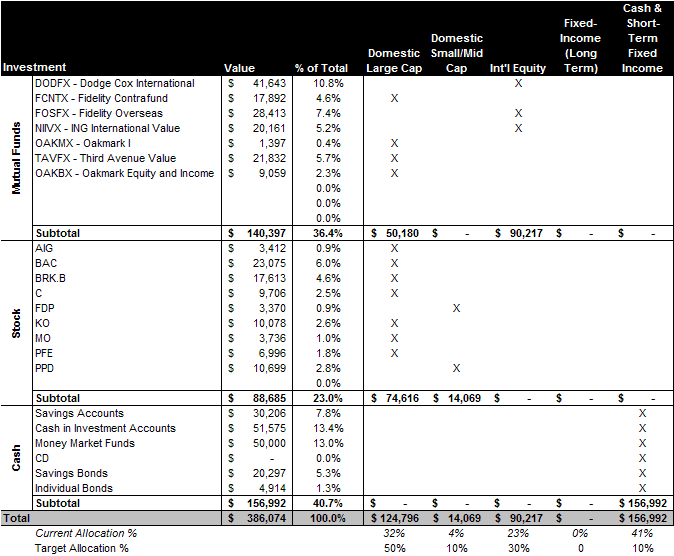
As a starter, I am sharing my portfolio at the end of 2005. A couple of notes before you start reading:
- Size of the portfolio is less than what I reported as net worth. I don't count employee stock options, which I don't think I have an effective management strategy other than "vest and hold". Also, I don't count my net worth currently denominated in CNY (Chinese Yuan) -- the CNY-part is mostly in cash/money market accounts. Until I cleared up my mind with regard to foreign exchange risk management, I will not consider that as an integral part of my portfolio.
- Cash: 41% of the portfolio is still in cash and equivalents. Many of you still remember we sold our house before our relocation in October, and ended up with loads of cash. At the end of October, our cash position was more than 80% of our portfolio, and we had made quite a few mutual fund/stock purchases since then. The goal is 10% for now.
- Mutual Fund: The positions with an asterisk are in our 401(k)s -- our mutual 401(k) plan has a list of (arguably) good funds. We also supplement that with more international and domestic large caps funds in after-tax accounts. I intend to keep 60% of our portfolio in mutual funds.
- Stocks: I will keep no more than 30% of my portfolio in individual stocks and keep no more than 10 such positions. All positions over $4,000 were established in the last two months ... you can clearly see I have an appetitie for high yielding blue chips recently.
Now I open up my portfolio for your feedback. More posts to discuss certain components of the portfolio will certainly follow.

2004 was not lenient on me in terms of portfolio performance. In my actively-managed accounts, namely after-tax account at AmeriTrade and Roth IRA accounts at Fidelity and BrownCo, I completed eight transactions, only to see a loss of $3,572.56 at year end. The ARR for ... Read
Sometime next week, I will sell my first batch of vested Stock Award shares of Microsoft, immediately after it becomes vested on August 29th. I briefly discussed this choice back in early July but I feel it's worthwhile to put together a holistic view of ... Read
Here are my comments. I feel you have been somewhat narrow on your approach to the individual stocks. While there is no perfect stock pick (there is always something negative about every company) - I think you have been swayed by the high div yield on your picks. You are overexposed to financials in general and insurance in particular. Except for PPD (which I don't know much about) you might as well have invested in a Dividend ETF since it will be the same picks. I wont give specific stock tips since but I think you should be looking under the rocks a little more. You have a special vantage of being in China. Look at companies that you think might have upside in Asia but that are just getting into that market. Just one idea but I think you can take a little more calculated risk or if you want stability then just go with an ETF.
Are you playing for a short squeez with PPD?
Why the savings bonds?
Have you considered something like RBS Preferred Stock as a replacement for Bonds?
I think your dividend strategy is spot on. I just posted my favorite dividend-paying stocks on my blog.
Have you considered a tax-free muni fund? I recently invested in PML... it's a PIMCO managed closed-end muni fund. It returns 5.8% tax free.
Holy cow. Get out of contrafund ASAP. I lost so much money in that turkey. It is a really really bad fund that had a good run in the 90s but has been horrible since. Save your money while you still can!
I am in agreement with the first writer. You seem overly in certain sectors, value, international, finance & insurance group. Also, I would guess to say that the domestic mutual funds you have are large cap and I am sure that you have duplication of picks. The morningstar website is a good area for checking crossing of mutual funds for holdings.
My portfolio used to look something like yours. Now I've been getting out of a lot of the stocks and simplifying into more low-expense index funds. Stockpicking requires more time and effort than I'm willing to give - if I don't spend that time, I see it as akin to gambling.
dtamura -
MM doesn't have any real debt; the closest thing he has is 0% balance credit card offers. The guy saves a ridiculous amount of his income. The best way for him to increase his net worth is via prudent investing.
I would dump all the individual stocks and purchase their respective ETF. For Dividends I would buy DVY or for Financials XLF. The best part of the ETFs is that they trade options and you can continuously make money threefold:
1. ETF appreciation
2. Sell Call Options (covered calls)
3. Collect dividends (if available)
Plus you get to:
4. Mitigate risk of single stocks (crooked CEOs)
5. Avoid ridiculous mutual fund fees.
6. Get out in an instant if you get a bad vibe!
oh and one other thing I would definitely do is move about 1/3 of the free cash offshore-far away from the hands of dumb politicians. And it wouldn't kill you to buy some gold. Based on this portfolio, at least $5000 worth of gold coins - either Canadian Maple or American Eagles or Credit Suisse Bars.
ContraInvestor...I am not sure you can support your negativity of Fidelity's Contrafund with facts. It has done very, very well for me over the past year and its 5 & 10 year returns are sounds. Equally impressive is its ability to maintain a low expense %.
You need to clean up your portfolio. With a value of $386,000, you should not have any position of less than $10,000.
By having less than that, you're allowing yourself to be lazy and avoid properly thinking about your investment, it's potential risk and return.
Clean the clutter, clean the cobwebs. Commit to positions of relatively low risk with potential for good returns.
My 2 cents ...
Jay Walker
If I remember correctly, you are young, so I would bump up the small/mid cap positions to at least 15%, there are several good funds you can invest to.
I would also check out 10 largest holdings in each of your mutual funds to make sure you don't invest in the same stocks on the side.
